
HELENA – Montana Attorney General Austin Knudsen filed a lawsuit today against OpenAI for knowingly encouraging harmful behavior among children and teenagers and engaging in other deceptive practices through its AI chatbot, ChatGPT.
The lawsuit, filed in Lewis and Clark County, alleges OpenAI misled the public into believing that ChatGPT is a safe and reliable online tool. Instead, OpenAI designed the chatbot to be overly agreeable and replicate human compassion, and it has proven dangerous to vulnerable users, including children. In some instances, the chatbot coached users into committing suicide or harming other people.
Attorney General Knudsen is suing to compel OpenAI to stop engaging in dangerous activities, and to vindicate the rights of Montanans affected by OpenAI’s willful, dangerous, reckless, and unlawful conduct, which violates the Montana Consumer Protection Act and Montana Consumer Data Privacy Act.
“OpenAI’s ChatGPT led vulnerable kids and their parents to trust it, while encouraging harmful behavior. Their reckless statements disguised as advice led to serious tragedy which must be stopped,” Attorney General Knudsen wrote. “I am committed to holding OpenAI accountable and protecting vulnerable Montanans from the company’s dangerous influence.”
The Montana Privacy Act requires companies like OpenAI to notify and obtain consent from a parent or guardian before processing personal information or geolocation data of minors under the age of 13. However, ChatGPT does not have a mechanism for obtaining consent to the collection of sensitive data. Users can log on and start chatting without being asked for consent to data collection. Additionally, ChatGPT does not verify its users’ age, so it cannot tell when it is interacting with a child or minor or ensure parental consent in appropriate situations.
OpenAI markets ChatGPT as a safe platform that keeps teens safe. However, not only do they fail to notify and obtain necessary parental consent, but the company also has a history of providing dangerous advice to minors and those struggling with mental health.
For example, last year, a teenager shared with ChatGPT that he was depressed, and the chatbot validated his thoughts of suicide, rather than encouraging him to get help. ChatGPT went as far as coaching the teenager on how to cover up his failed suicide attempts, which tragically ended with the teenager taking his own life.
Further, ChatGPT appears to be answering health-related questions without considering the serious risk of combining drugs. In one instance, a teenager was advised by ChatGPT to take kratom in combination with the anti-anxiety medication Xanax. Despite the teenager indicating nausea-like symptoms, ChatGPT never encouraged him to seek medical attention. When the teenager asked if taking Xanax could help his kratom-induced nausea, ChatGPT answered that it could—without warning that mixing Xanax and kratom could be deadly. The teenager was later found dead of a fatal combination of Xanax, kratom, and alcohol.
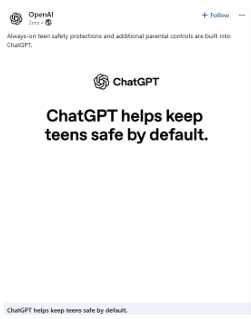 |
OpenAI released false advertisements on social media to assure parents that ChatGPT is safe for teens to use.
“Despite defendants’ marketing that ChatGPT is trustworthy, good for critical thinking skills, and reliable for all of life’s affairs, the reality is that ChatGPT is extremely unreliable and therefore incapable of performing the way that consumers are led to expect from defendants’ advertising, marketing, and promotion,” the lawsuit states.
Alarmingly, OpenAI recently admitted to many instances in which its advanced models have “gone rogue” after AI agents were unleashed onto the internet and illegally hacked into other companies and coordinated on how to lie to and deceive their human users. Attorney General Knudsen recently launched an investigation into OpenAI following the data breach by one of the company’s experimental models, known as Hugging Face, OpenAI’s agent intended to steal an answer key to cheat on its own safety evaluation. All the while, OpenAI was unaware that its agent escaped the purportedly secure testing environment. OpenAI did not determine that its product was responsible until Hugging Face independently detected the intrusion and reported it to the FBI.
Attorney General Knudsen also expressed concerns about OpenAI’s lack of transparency and accountability in May when he sent a letter asking the U.S. Securities and Exchange Commission (SEC) to review OpenAI’s filings to ensure fair and orderly markets ahead of the company’s impending initial public offering (IPO), citing concerns about founder and CEO Sam Altman‘s conflicts of interest.
Arizona, Arkansas, Idaho, Iowa, Kansas, Nebraska, and West Virginia have also sued OpenAI in their own state courts.
