History/Background

The Milltown Dam was located just east of Missoula, Montana, at the confluence of the Clark Fork and Blackfoot rivers. After construction in 1906, the dam withstood the Clark Fork Basin flood of record in 1908. During the past century, mine waste materials washed downstream from the Butte and Anaconda mining and smelting activities, creating some 6.6 million cubic yards (mcy) of contaminated sediment accumulation behind the Milltown Dam. The Milltown Reservoir/Clark Fork River Superfund Site was listed on the National Priority List (Superfund) in 1983. The NRDP integrated restoration actions with the EPA and BP-Atlantic Richfield (BP-AR) remedial activities to create a naturally functioning river and floodplain system where the reservoir once existed.

NRDP developed the Restoration Plan for the Clark Fork and Blackfoot Rivers near the Former Milltown Dam (Restoration Plan) in collaboration with the Montana Fish, Wildlife and Parks, United States Fish and Wildlife Services (USFWS), Confederated Salish and Kootenai Tribes (CSKT).

In 2004, EPA and the State of Montana released the Record of Decision for the cleanup of the Milltown Site, which included partial dam removal, removal of 2.3 mcy of the sediment impacting drinking water supplies, and disposal location for the sediments in the Opportunity Ponds near Anaconda. Sediments would be transported to the ponds by rail. The reservoir pool level would be lowered to the lowest possible level during removal of the sediments. In 2006, the State and EPA entered into a Consent Decree with the responsible parties, Atlantic Richfield Company and Northwestern Corporation, to implement the remedy and restoration.  Important benefits included the integration of restoration and redevelopment of the project area and adjoining areas; returning of the Clark Fork River to a free-flowing state; and allowing fish passage between the Clark Fork River below the dam and the Clark Fork River above the dam as well as the Blackfoot River to Stimson Dam resulting in substantial improvements to the native and recreational fisheries. The work laid the groundwork for the development of the Milltown State Park.

Remedial actions construction was completed in 2010 and restoration action construction completed in 2012. Since the completion of construction activities, NRDP has been involved in monitoring (see monitoring links) and maintenance activities and assisting Montana Fish, Wildlife & Parks (FWP) with the establishment of the Milltown State Park.

2025 marked 15-years since completion of restoration actions and monitoring completed per the Restoration Monitoring and Maintenance Plan indicates the restoration actions implemented are naturally self-maintaining. Monitoring reports from the 2025 monitoring activities will be linked here when they become available.

In addition, the Montana Department of Transportation (MDT) is continuing to work with others on the improvement and upgrading of the Interstate 90 highway bridges located on the Blackfoot River. Interstate 90 bridge upgrades were completed in 2020 and MDT is working with the railroads to complete the removal of the former bridge piers that are located within the Blackfoot River beneath the Interstate bridges scheduled for 2027.

Milltown Site Images

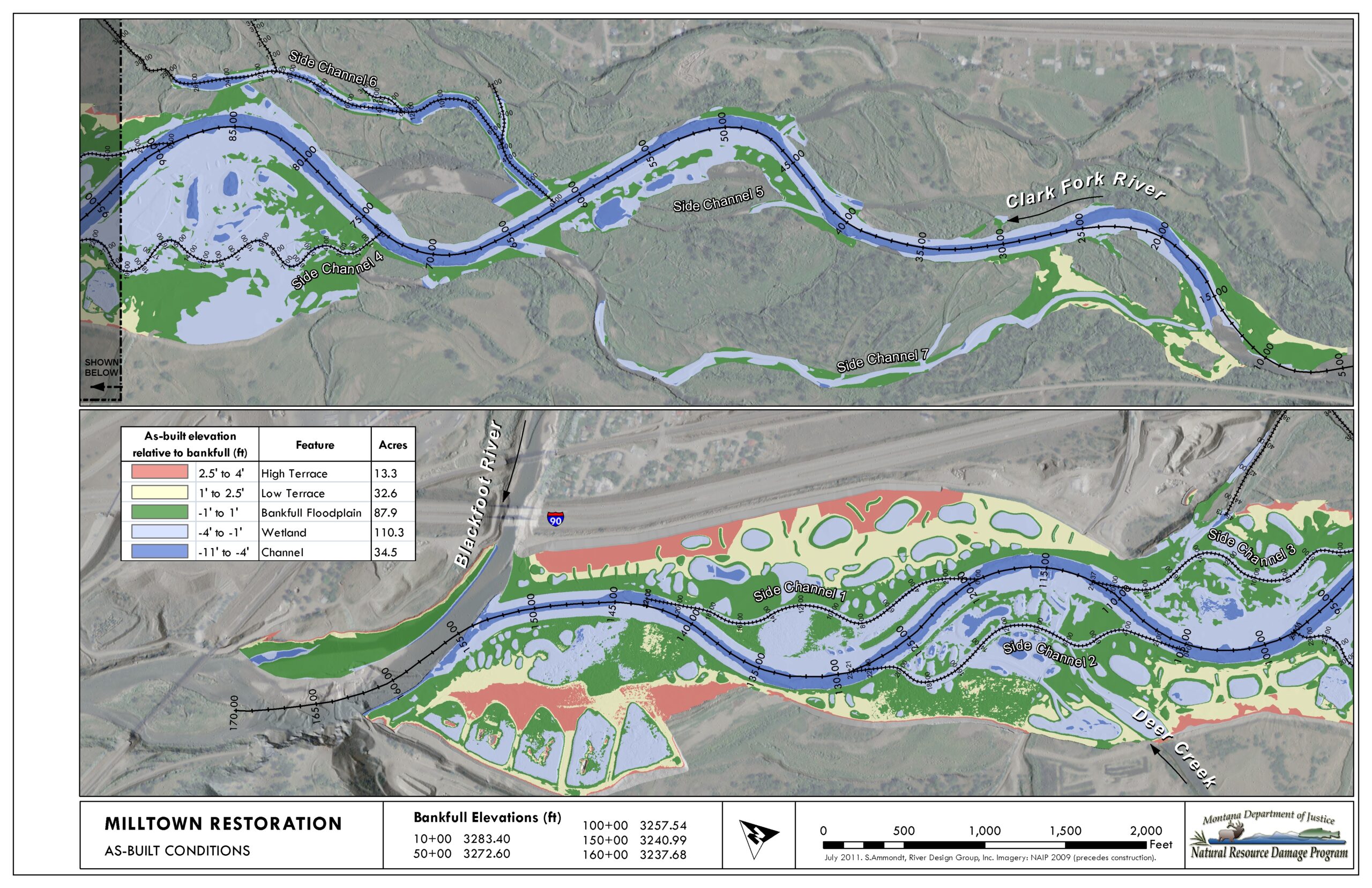
Milltown Restoration As-Built Conditions Image